

Difficulty falling asleep can be incredibly frustrating, especially when you’re physically exhausted. You’ve been looking forward to going to bed, but the moment your head touches the pillow, your brain suddenly seems wide awake.
Thoughts start racing. You replay conversations, think about tomorrow’s responsibilities, and find yourself unable to fall asleep despite feeling completely drained.
Difficulty falling asleep is a common problem, but why does our brain sometimes seem unable to slow down precisely when we need rest the most?
To understand this, we need to explore the nervous system, hormonal rhythms, and the mechanisms that regulate sleep.
Difficulty Falling Asleep: Understanding Hyperarousal
One of the mechanisms associated with many forms of insomnia is known as hyperarousal.
Hyperarousal refers to a state of excessive physiological or cognitive alertness that can persist even when the body feels physically exhausted.
Normally, as bedtime approaches, our level of alertness gradually decreases.
However, several factors may maintain excessive activation:
- Persistent mental activity.
- Worry and repetitive thoughts.
- Increased activity in stress-response systems.
- Excessive attention to sleep difficulties.
- Habits that unintentionally reinforce wakefulness.
The result is a frustrating paradox: your body needs rest, but your brain remains on alert.
Difficulty Falling Asleep: Could Cortisol Be Involved?
Cortisol is a hormone produced by the adrenal glands under the regulation of the hypothalamic-pituitary-adrenal axis.
It plays an essential role in the body’s response to stress and also participates in regulating the sleep-wake cycle.
Understanding the Normal Cortisol Rhythm
In people with relatively regular sleep schedules, cortisol follows a circadian rhythm.
Levels are generally relatively low during the early part of the night and rise during the latter part of the night, reaching higher concentrations around waking.
This rhythm helps prepare the body for daytime activity.
What Happens During Chronic Stress?
Prolonged stress may influence the physiological systems involved in alertness and stress regulation.
Some studies have identified differences in cortisol regulation among people experiencing insomnia.
However, insomnia is not always associated with elevated cortisol, and a single cortisol measurement cannot establish its underlying cause.
Sleep disorders are complex and cannot be explained by one hormone alone.
Melatonin and Difficulty Falling Asleep
Melatonin is a hormone produced primarily by the pineal gland during the biological night.
Its secretion is regulated by the body’s central circadian clock, located in the hypothalamus.
Light exposure plays an essential role in synchronizing this clock.
As biological nighttime approaches, melatonin secretion increases, signaling that the body’s rest period is approaching.
However, melatonin is not simply a natural sleeping pill.
Its primary function is to communicate biological timing.
This is why melatonin can be particularly useful for certain circadian rhythm disorders without necessarily resolving every form of insomnia.
Exposure to bright light in the evening may delay this biological signal in some individuals.
Difficulty Falling Asleep: The Role of Adenosine
Throughout the day, our biological need for sleep gradually increases.
This process is known as homeostatic sleep pressure.
Adenosine is one of the molecules involved in this regulation.
The longer we remain awake, the greater our sleep pressure generally becomes.
However, falling asleep easily also depends on the alignment of our circadian rhythms and a sufficiently low level of arousal.
This helps explain why someone may feel extremely tired yet remain unable to fall asleep.
How Caffeine Affects Sleep
Caffeine blocks certain adenosine receptors.
As a result, it temporarily reduces feelings of sleepiness without eliminating the body’s physiological need for sleep.
Its half-life is generally several hours, although individual differences can be substantial.
For sensitive individuals, even caffeine consumed relatively early in the day may interfere with nighttime sleep.
Evaluating coffee, tea, energy drinks, and other sources of caffeine can therefore be useful when investigating difficulty falling asleep.
To learn more about how caffeine affects sleep, read my article on jet lag and sleep, where I explain why I personally avoid stimulants when traveling.
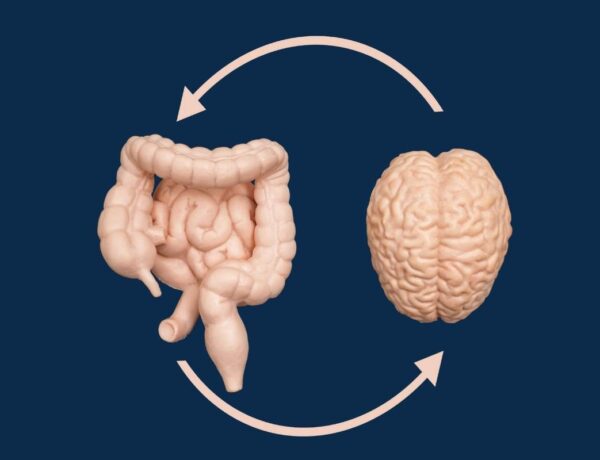
The Gut–Brain Connection and Sleep
In my naturopathic practice, I pay particular attention to the interactions between the digestive and nervous systems.
These systems communicate through neural, immune, and hormonal pathways.
The gut microbiome also participates in this communication.
Research suggests that the microbiome and its metabolites may interact with mechanisms involved in sleep regulation and circadian rhythms.
Conversely, insufficient sleep and circadian disruption may influence digestive function.
However, these biological connections should not be confused with established treatments. Current evidence does not demonstrate that a specific microbiome intervention reliably treats chronic insomnia.
Nevertheless, digestive symptoms can directly interfere with sleep.
Acid reflux, abdominal discomfort, and bloating may make falling asleep more difficult.
Considering digestive health can therefore be relevant when exploring persistent sleep problems.
Why Trying Harder to Sleep Can Make Insomnia Worse
When someone begins experiencing difficulty falling asleep, they may gradually develop anxiety surrounding bedtime.
They check the clock, calculate how many hours of sleep remain, and worry about how exhausted they’ll feel the next morning.
Bedtime becomes associated with frustration rather than relaxation.
Over time, the bed itself may become a cue for wakefulness.
This learned association can contribute to conditioned insomnia.
It’s one reason why trying to force sleep may sometimes make the problem worse.
Difficulty Falling Asleep: What Can Help?
Several practical habits may help support healthier sleep patterns.
1. Maintain Consistent Wake-Up Times
Waking up at relatively regular times helps stabilize circadian rhythms.
2. Evaluate Your Caffeine Intake
Some individuals are particularly sensitive to caffeine.
Gradually reducing or eliminating caffeine may help when it contributes to sleep difficulties.
3. Create a Transition Between Day and Night
Quiet activities, dim lighting, and reducing work-related stimulation can support relaxation before bedtime.
4. Avoid Fighting Sleep
If wakefulness becomes prolonged and frustrating, temporarily leaving the bed for a quiet activity may help weaken the association between bed and sleeplessness.
5. Identify Contributing Factors
Pain, acid reflux, anxiety, medications, sleep-related breathing disorders, and circadian rhythm disturbances may require specific evaluation.
When insomnia becomes chronic, cognitive behavioral therapy for insomnia (CBT-I) is recommended as the first-line treatment.
Conclusion: Understand Your Sleep Rather Than Fight It
Difficulty falling asleep does not necessarily mean your body lacks melatonin or needs more sleep.
It may result from a complex interaction between nervous system arousal, circadian rhythms, lifestyle habits, and various physical or psychological factors.
Rather than trying to force sleep, understanding what’s preventing the natural transition from wakefulness to rest is often more helpful.
In my naturopathic practice, I consider lifestyle habits, stress management, digestive health, and the interactions between the nervous system and the gut.
Are you struggling with difficulty falling asleep or unrefreshing sleep?
I offer personalized consultations, both in person and online, to help explore factors that may be contributing to your sleep difficulties, alongside appropriate medical care when needed.
Béatrice Levinson – Naturopath, 38 Years of Experience, Specializing in the Gut–Brain Connection.